
The AfrOrigens Institute is a Brazilian non-profit organization dedicated to the research, location, study, and conservation of underwater cultural heritage related to the transatlantic slave trade, as well as to the preservation of the associated histories, especially those connected to Afro-descendant quilombola communities.
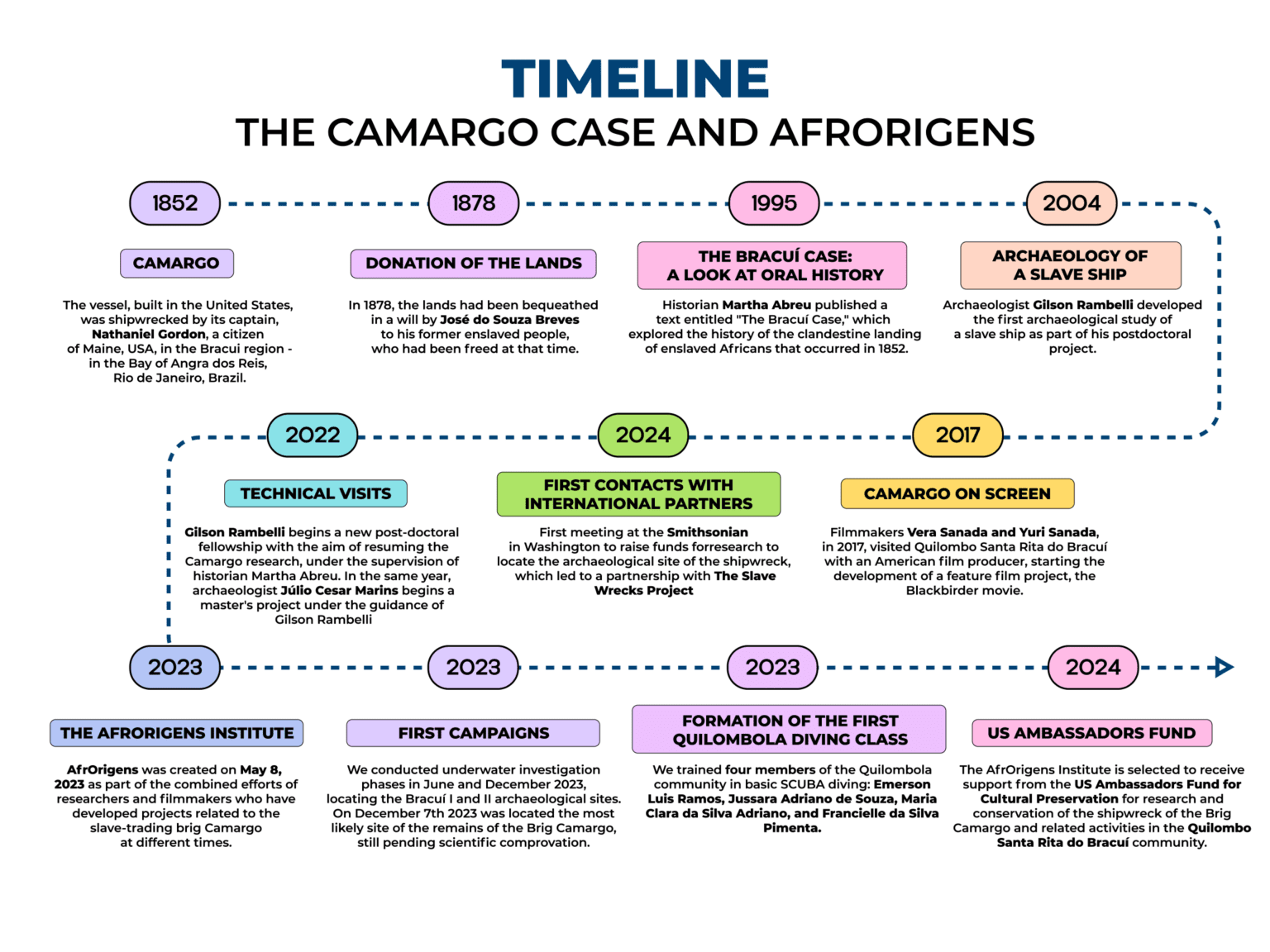
AfrOrigens was founded on May 8, 2023, as the result of the joint efforts of researchers and filmmakers who, at different times, had already developed projects related to the slave brig Camargo. Together, they united their efforts to continue the search for the material remains of the shipwreck, its archaeological research, and dissemination. Strategically, the project serves as a political tool for the empowerment of quilombola communities in their demand for historical reparation and social justice.
To understand the history of the slave brig Camargo, we must return to the mid-19th century at the mouth of the Bracuí River. Built in the United States, the vessel was deliberately sunk in 1852 by its captain, Nathaniel Gordon, a citizen of Maine, in the Bracuí region in the Bay of Angra dos Reis, Rio de Janeiro, Brazil. This was done as a strategy to conceal the clandestine trafficking of Africans after disembarking more than 500 enslaved Africans brought from Mozambique.
The Santa Rita do Bracuí plantation, owned by Commander José de Souza Breves, played an active role in this clandestine trade. It served as both a port and a reception site for newly arrived Africans, who were then distributed to coffee plantations in the Paraíba Valley. Since the late 19th century, the descendants of the enslaved on this plantation have faced repeated attempts to be expelled from their lands. However, through oral tradition and coded narratives in jongo songs, they preserved the memory that in 1878 José de Souza Breves had left the lands in his will to his former slaves, who had by then been freed. Within the community’s memory, the history of the Camargo disembarkation also remained alive.
In the 1990s, the repression of the illegal African slave trade, particularly the case of the Camargo, became a topic of historiographical interest, validating the community’s oral tradition with extensive historical documentation. In 1995, the book Resgate. Uma janela para o Oitocentos was published, organized by Hebe Mattos and Eduardo Schnoor. Among the essays in the book, Martha Abreu (founding member of AfrOrigens) contributed the chapter Caso Bracuí, which explored the clandestine landing of enslaved Africans in 1852. From this foundation, incorporating community oral traditions into local history, the project Passados Presentes emerged, establishing a long-term partnership with the quilombola community.
In the early 2000s, archaeologist Gilson Rambelli (founding member of AfrOrigens), a pioneer in maritime archaeology in Brazil aligned with international standards, developed the first archaeological proposal to study a slave ship through his postdoctoral project Underwater Archaeology of a Slave Ship: The History Not Found in Books, conducted under the supervision of archaeologist Pedro Paulo Abreu Funari between 2004 and 2007. This was one of the pioneering projects worldwide, proposing the underwater archaeological study of the remains of the Camargo brig and its preservation as underwater cultural heritage.
In 2001, filmmakers Vera Sanada and Yuri Sanada (founding members of AfrOrigens) moved to Bracuí and, upon learning the community’s oral history, began researching a script for a film on the Camargo and its controversial captain Nathaniel Gordon. He was the only captain in U.S. history to be indicted and executed for slave trading, when newly elected President Abraham Lincoln applied the penalty in 1860. In 2017, as part of developing a feature film, they visited the Quilombo with an American film producer to advance the Blackbirder project (http://produtora.aventura.com.br/blackbirder/), and have since moved forward with documentary projects on the Camargo and AfrOrigens activities. In 2021, on the recommendation of Martha Abreu and Gilson Rambelli, they held a meeting at the Smithsonian Institution in Washington, D.C., to raise funds to resume research on locating the wreck site, leading to a partnership with the Slave Wrecks Project.
In 2022, archaeologist Gilson Rambelli began a new postdoctoral project under the supervision of historian Martha Abreu, titled Archaeology of a Slave Ship, aimed at resuming research on the Camargo. In the same year, archaeologist Júlio Cesar Marins (founding member of AfrOrigens) began his master’s project under Rambelli’s supervision, titled Underwater Archaeological Research on the African Diaspora in the Bay of Angra dos Reis, RJ: Underwater Archaeological Study of the Wreck Site of the Brig Camargo, a study still in progress.
For this renewed effort, in 2022 Professor Gilson Rambelli invited archaeologist Luis Felipe Freire Dantas Santos, PhD, a specialist in film and a Black activist with extensive professional experience across Brazil, who would later be the founding member elected as the first president of the AfrOrigens Institute.
After the first technical visits to Angra dos Reis in December 2022, financed by the Slave Wrecks Project, the group decided to mobilize to formally establish the AfrOrigens Institute. Its purpose was to empower traditional communities in the appropriation of slave shipwreck sites as powerful and publicly compelling platforms to promote social transformation and challenge persistent injustices embedded in Brazilian and global society. The Institute was officially founded on May 8, 2023.
Thanks to the dedication of all those involved in the various stages of research during our first year as an institute, in December 2023 we were able to locate a wreck site, still under investigation, but already showing evidence of identification with the Camargo.
The participation of the Santa Rita do Bracuí quilombo has been fundamental in this process, both in advancing the Camargo case and in serving as an inspiring model of cultural heritage appropriation as a tool for territorial defense and historical reparation. In June 2023, we held our first audiovisual workshop in partnership with WITNESS Brasil, and in May 2024 we trained the first quilombola diving class (basic level), in partnership with NAUI Brasil and AQUAMASTER Dive Center. We hope to train many more members of the quilombola community, as we understand that heritage preservation goes beyond the physical integrity of sites. It is essential to prepare multipliers in the conservation of archaeological sites, enabling them to manage what relates to these sites and benefit from them in various ways. These benefits range from the future development of cultural tourism to public advocacy for historical reparations for crimes that left lasting legacies of social injustice and inequality.
At the end of 2024, the AfrOrigens Institute received a grant of US$ 295,000, in installments through 2027, from the U.S. Consulate General in Rio de Janeiro to support the conservation of the remains of the Camargo. The funding came from the U.S. Ambassadors Fund for Cultural Preservation (AFCP), which since 2001 has supported the preservation of global cultural heritage. We believe that investment in the preservation and conservation of cultural heritage can strengthen the struggle for territorial rights, the valorization of Afro-descendant identity, and the creation of sustainable income-generation opportunities, connecting past, present, and future to promote social transformation and historical reparation.